


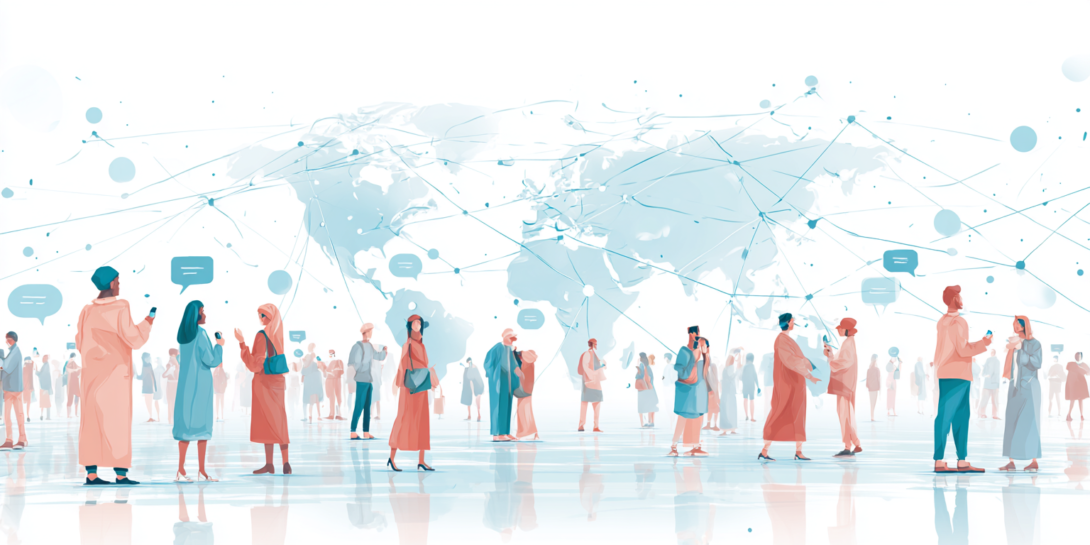
The relationship between citizens and public life has changed dramatically in the digital age. In earlier decades, participation in political and social processes was often limited by geography, access to institutions, and control over information. People joined political life through town meetings, printed newspapers, party structures, protest movements, community organizations, and occasional elections. While these channels still matter, IT tools have fundamentally expanded how citizens observe, discuss, organize, and influence public affairs. Today, participation is no longer shaped only by physical presence. It is increasingly shaped by digital access, platforms, communication systems, and data-driven technologies.
IT tools now play a central role in transforming how people engage with society and politics. They affect not only how information is distributed, but also how public opinion is formed, how communities mobilize, and how governments are held accountable. In many cases, digital tools have made civic participation more immediate, visible, and inclusive. At the same time, they have introduced new risks involving misinformation, manipulation, surveillance, and unequal access. Their role is therefore both empowering and complex.
One of the most important ways IT tools have changed public participation is by lowering the barrier to entry. In the past, becoming politically engaged often required access to organizations, media channels, or physical spaces of discussion. Today, a citizen can follow legislative developments, read public analysis, sign petitions, join online campaigns, contact representatives, or participate in community discussions through a smartphone. This accessibility has widened the range of people who can take part in public life, including those who may have been excluded by distance, disability, cost, or lack of institutional connections.
Social media platforms are perhaps the most visible example of this transformation. They have turned millions of users into active participants in public discourse rather than passive consumers of information. Citizens can react to political decisions in real time, amplify marginalized issues, share local experiences, and connect with others around common concerns. Public debate has become faster, more decentralized, and more visible. A local issue can quickly gain national or even global attention if digital communities mobilize around it.
This shift has been especially important for grassroots activism. IT tools have enabled ordinary citizens to organize without relying entirely on traditional gatekeepers such as political parties, newspapers, or large institutions. Online platforms allow people to coordinate protests, spread awareness, collect donations, recruit volunteers, and circulate eyewitness documentation. In many cases, movements that begin as local digital conversations develop into significant public campaigns. This has altered the balance of power between institutions and citizens by making mobilization more flexible and less dependent on formal structures.
Another major area of change is access to information. Search engines, online archives, open data portals, interactive maps, digital journalism, and fact-checking tools have all expanded the citizen’s ability to understand public issues. People can now compare sources, analyze statistics, monitor official statements, and follow public spending with a level of detail that was once available only to professionals or insiders. This can strengthen democratic culture by encouraging informed participation rather than passive acceptance.
Government technology has also shaped this transformation. In many countries, digital public services allow citizens to register concerns, access legal information, file documents, participate in consultations, and communicate with authorities more efficiently. E-governance platforms can make institutions feel less distant and more responsive. When designed well, they reduce bureaucracy, improve transparency, and strengthen public trust. Citizens are more likely to engage when participation feels practical and when institutions provide visible channels for response.
IT tools also influence political life through data visualization and digital storytelling. Complex public issues such as housing inequality, climate policy, healthcare access, police violence, or electoral trends can be made more understandable through charts, maps, dashboards, and interactive media. This matters because citizens do not engage only through slogans or emotions. They also engage through comprehension. The ability to present public information clearly makes it easier for people to recognize patterns, evaluate claims, and connect personal experience to broader structural realities.
At the same time, the transformation of civic participation through technology is not purely positive. One major concern is misinformation. The same tools that allow rapid communication also allow false information to spread at extraordinary speed. Citizens are exposed to manipulated images, misleading statistics, coordinated propaganda, and emotionally charged content designed to provoke outrage rather than understanding. As a result, participation can become reactive instead of informed. In such an environment, digital access alone does not guarantee democratic strength. It must be accompanied by media literacy and critical judgment.
Another serious issue is algorithmic influence. Many citizens encounter political information not through deliberate search, but through platform feeds shaped by recommendation systems. These systems reward attention, engagement, and emotional intensity, which can distort public discussion. Certain voices become more visible, while others are pushed to the margins. This creates a political environment in which participation is increasingly mediated by private technological infrastructures. Citizens may feel empowered because they can speak, but visibility itself is often controlled by opaque systems they do not govern.
Digital surveillance also complicates the picture. In some contexts, IT tools that support participation can also be used to monitor, profile, or intimidate citizens. Activists, journalists, and ordinary users may face online harassment, data collection, or state observation. The same technologies that enable organization can create digital vulnerability. This means that the expansion of participation must be considered alongside questions of privacy, security, and digital rights. Public life becomes more open through technology, but also more exposed.
There is also the issue of inequality. Not every citizen has equal access to devices, stable internet, digital skills, or trustworthy information environments. Some people are highly connected and digitally fluent, while others remain excluded from important parts of public life because of age, income, geography, disability, or educational background. If governments and institutions move too quickly toward digital participation without addressing these gaps, they risk replacing old exclusions with new ones.
Despite these challenges, IT tools have undeniably changed the meaning of citizenship in the modern world. Participation is no longer limited to voting every few years or consuming information from above. Citizens now contribute to public life through online discussion, data sharing, collaborative platforms, digital watchdog work, civic apps, and decentralized networks of activism. The line between observer and participant has become less fixed. Even small digital actions can contribute to broader visibility and public pressure when connected to larger communities.
For this reason, digital literacy has become a civic skill, not only a technical one. To participate meaningfully in political and social life today, citizens must know how to evaluate sources, protect their data, navigate online debate, recognize manipulation, and use digital tools responsibly. The ability to take part in public life increasingly depends on the ability to function critically in digital space.
In the end, the role of IT tools in public and political participation is transformative because these tools reshape the conditions of visibility, access, organization, and influence. They give citizens new ways to speak, connect, and act, while also exposing them to new systems of control and distortion. Their true democratic value depends not simply on their existence, but on how societies design, regulate, and use them.
Technology alone does not create active citizenship. But it has changed what active citizenship looks like. In the digital era, public participation is faster, broader, and more networked than before. The central challenge now is to ensure that these tools strengthen democratic life rather than weaken it. When citizens can access information, organize collectively, and communicate across barriers while still protecting truth, privacy, and inclusion, IT tools can become not just instruments of convenience, but instruments of democratic renewal.